Glossary of General Service Terms
A.A.W.S. — Alcoholics Anonymous World Services, Inc., one of the two operating corporations of the General Service Board; oversees the operations of the General Service Office and serves as the publishing company for Conference-approved and service literature.
About A.A. — About A.A. is the newsletter from the General Service Office of the U.S. and Canada for professionals of all types who deal with alcoholics, including professionals in the fields of healthcare, law, corrections and clergy.
Additional committee consideration (or, simply, committee consideration) — An item that was discussed by a Conference committee, but with no action taken or recommendation made to the Conference as a whole. Serves as a suggestion to the corresponding trustees’ committee. Ad hoc committee — A committee established on a temporary or short-term basis to accomplish specific tasks not easily provided for elsewhere in the committee system. Each ad hoc committee has a particular goal to achieve or product to provide to its initiating body; when its task is completed, the committee is dismissed.
Advisory Action — Represents the informed group conscience of the Fellowship, as the result of a recommendation made by a Conference committee or a floor action that has been approved by the Conference body as a whole.
Agenda item — The final agenda for any Conference consists of items suggested by individual A.A. members, groups, delegates, trustees, area assemblies, area committee members, and directors/staff members of A.A.W.S. and the Grapevine. Whatever its origin, any agenda item follows the same path to the Conference agenda: the A.A. staff studies it in the light of previous Conference actions, then passes it on to the trustees’ Conference Committee or the appropriate Conference committee to determine when, where and whether it will appear on the Conference agenda.
Alternate — A service worker who, at group, district, or area level, assists, supports and participates in service responsibilities, and stands ready to step into the service position if the person occupying it is no longer able to serve.
Appointed committee member (ACM) — An A.A. member who serves on a specific trustees’ committee (for example, Public Information or Corrections) because of his or her knowledge and experience in the field.
Area — The U.S. and Canada are divided into 93 geographic areas. Conference delegates come from each area. Normally there is one area to a state or province, except in heavily A.A.-populated places, where there may be two, three or more areas in a state or province. Some areas include portions of more than one state or province.
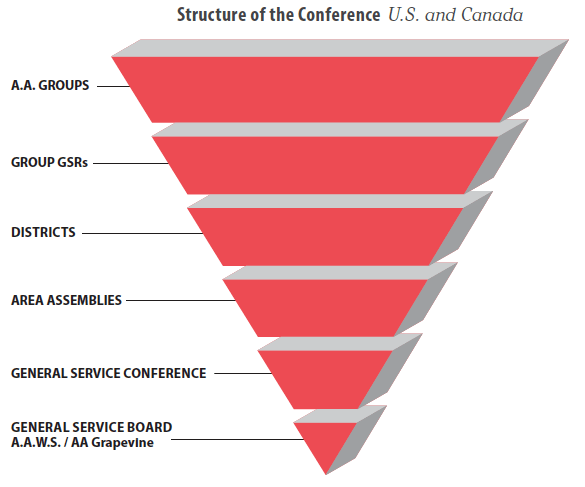
Area assembly — A meeting of GSRs and committee members to discuss area affairs and, every other year, to elect a delegate and committee officers.
Area committee — A committee made up of district committee members (elected by the GSRs in each district) and area committee officers. The area committee generally serves as a steering committee for the area.
Box 4-5-9 — The quarterly newsletter from the U.S./Canada General Service Office. This newsletter includes information about A.A. service, literature, events, sharing from groups, service committees and individual members.
Class A trustee — A nonalcoholic trustee of the General Service Board.
Class B trustee — An alcoholic trustee of the General Service Board.
Conference — The General Service Conference; this can mean either the structure involving committee members, GSRs and delegates in an area, or the annual meeting of Conference delegates each spring in New York.
Concepts — The twelve principles of service that have emerged from A.A.’s service accomplishments and mistakes since its beginning, as set forth by Bill W. in The A.A. Service Manual/Twelve Concepts for World Service.
Conference-approved literature, videos and films — Pamphlets, books, videos and films produced under the auspices of various Conference and trustees’ committees that the appropriate Conference committees have reviewed and recommended to the Conference for its approval, and that have been approved by the Conference.
Custodial oversight — The term describing the relationship between the General Service Board and its two operating corporations, A.A. World Services, Inc. and AA Grapevine, Inc., which provide vital services to the Fellowship. This relationship is described in Concept VIII.
C.P.C. — Cooperation with the Professional Community. C.P.C. committees at the district, area, trustee and Conference level help carry the message to professionals who work with problem drinkers.
Delegate — The A.A. member elected every other year to represent the area at the annual Conference meeting in New York and to bring back to the area the results of that meeting.
Director — A person who serves on the corporate board of directors of either A.A.W.S. or Grapevine. Nontrustee directors are A.A. members selected for business or professional experience that relates to the activities of the corporation. The directorate of both corporate boards also includes trustees and A.A. staff.
District — A division within an area, represented by committee member(s).
DCM — District committee member. An experienced GSR elected by other GSRs to represent the groups of their district in area committee meetings and to coordinate service activities in the district.
District meetings — Meetings of the DCMs and GSRs of groups in a district. General services — Movement-wide services, performed by anyone in the general service structure (GSR, DCM, delegate, etc.).
General Service Board (G.S.B.) — A board composed of fourteen A.A. trustees and seven nonalcoholic trustees that serves to safeguard A.A.’s Traditions and funds. The board has the responsibility of overseeing the General Service Office (G.S.O.), A.A. World Services, Inc., and the AA Grapevine, Inc.
General Service Conference — A conference linking the A.A. groups to the General Service Office and the General Service Board. It serves as the group conscience for A.A. as a whole. Although the Conference only meets for six days a year, the Conference members are active in Conference affairs throughout the year. Conference members are elected as representatives from each of 93 area assemblies. The assemblies themselves are elected by General Service Representatives (GSRs) from all A.A. groups.
General Service Office (G.S.O.) — The General Service Office — which provides services to groups in the U.S. and Canada and publishes A.A. literature.
GSR — General service representative. The link to A.A. as a whole and group contact with the General Service Office; voting member of the area assembly.
Grapevine (GV) — The international journal of Alcoholics Anonymous is available online and in print. AA Grapevine, Inc. is one of the two operating corporations of the General Service Board and is responsible for Grapevine operations and finances.
GVR — Grapevine representative: the group or district contact with the Grapevine office.
La Viña — Bimonthly Spanish-language magazine published by AA Grapevine.
Loners-Internationalists Meeting (LIM) — A confidential bimonthly bulletin sent to Loners, Homers, Internationalists, Port Contacts and Loner Sponsors.
Nontrustee director — An A.A. member who serves as a director on one of the corporate boards (A.A.W.S., Inc. or AA Grapevine, Inc.) who is not a trustee. They also serve as members of most standing committees of the General Service Board. Each corporate board has three nontrustee directors.
Panel — Refers to a group of delegates elected to begin serving at the General Service Conference in a particular year. Each panel is numbered for the Conference at which the area’s delegate will first serve. The two-year cycle frequently applies to area committee officers and committee members, as well.
Public information (P.I.) — Committees at the district, area, trustee and Conference level help carry the message by working with the media.
Region — A grouping of several areas from which a regional trustee comes to the board of trustees. There are six regions in the U.S., two in Canada.
Regional Forum — Weekend sharing and informational sessions held in each region every two years that improve communication at all levels of the Fellowship.
RLV — La Viña representative; the group or district contact with the Grapevine office. Rotation — The spiritual principle of sharing the responsibility for A.A. through changing leadership.
Service Manual — Full title: The A.A. Service Manual/Twelve Concepts for World Service. The manual explaining the general service structure and its year-round importance; includes the Conference Charter, General Service Board Bylaws and Twelve Concepts.
Sharing session — A group, district, area or Conference meeting in which everyone is invited to contribute ideas and comments on A.A. matters, and during which no actions are taken. Third Legacy Procedure — Method by which delegates to the General Service Conference as well as area officers are typically elected by their area’s assemblies.
Three Legacies — Recovery, Unity and Service. As noted by Bill W., the Fellowship’s chief inheritances from the first 20 years of Alcoholics Anonymous.
Trustee — A member of A.A.’s General Service Board. Fourteen trustees are A.A. members (Class B); seven are nonalcoholic (Class A).
Trustee-at-large — Two alcoholics (one from Canada and one from the U.S.) serve as trustees-at-large of the G.S.B. and represent the U.S. and Canada at the World Service Meetings and the Zonal Meeting of the Americas (REDELA).
District 7 is part of Area 93 of Alcoholics Anonymous.
General Service Information
The A.A. General Service Office is located in New York and serves as a hub of communications for A.A. Groups in the United States and Canada. They coordinate a wide variety of activities and services including: Collection and dissemination of shared experiences regarding group challenges and solutions, responding to correspondence and public information requests, and publishing of books and pamphlets approved by the General Service Committee.
The General Service Office is also the home of A.A. World Service, which oversees the publication, translation, and distribution of official A.A. literature. More >>>
In addition, the General Service Office produces a quarterly newsletter, BOX 459, which you can read here. More >>>
Delegate
The Area 93 Delegate is elected every other year to represent the Area at the annual General Service Conference in New York and to bring the results of that meeting back to the Fellowship. Since 1951, Area delegates have been elected as trusted servants, providing important leadership and a vital link between the groups and the Conference.
Throughout the year—especially in the months leading up to the Conference, usually held in late April—the Delegate asks the GSRs to share their group consciences on the General Service Conference Agenda Items and any other concerns their groups may have. Individual A.A. members are also welcome to share their thoughts. Group consciences are typically presented at the Pre-Conference Assembly, held in March or April, and may also be shared with the Delegate by email.
It has long been the custom of Area 93 to hold a “Delegate’s Report Back” in May or June each year. Afterward, the Delegate makes themselves available to visit districts throughout the Area to present the report and answer questions from the Fellowship.
Currently, our Area 93 Delegate is Rudy M. delegate@area93.org
District Committee Member (DCM)
The District Committee Member, or DCM, plays a vital role in General Service. While the GSR is the voice of the group, the DCM serves as the voice of the district. A district benefits from steady, principled leadership, and the GSRs often look to the DCM for guidance in carrying out their responsibilities and serving their groups.
GSRs rely on the DCM to help shape the district’s agenda, encourage participation, and foster a spirit of cooperation and service. The DCM’s role is to inspire and support rather than direct or control—helping trusted servants grow in confidence and effectiveness while respecting the group conscience at every level.
General Service Representative (GSR)
For most A.A. members, belonging to a home group is one of the keys to continuing sobriety. In the home group, members accept service responsibilities and learn to build and maintain meaningful connections with other recovering alcoholics. The home group also gives each member the privilege of voting on issues that affect the Fellowship as a whole; it is the foundation of the entire service structure. While many A.A.s attend other meetings, the home group is where they participate in business meetings and cast their vote as part of the group conscience. As with all group conscience matters, each member has one vote.
The role of the General Service Representative, or GSR, is essential to the purpose of General Service. Bill W. wrote in Concept I of The Twelve Concepts for World Service: “The A.A. groups today hold ultimate responsibility and final authority for our world services.” The GSR helps ensure that groups can fulfill that responsibility. When a GSR keeps the group informed and communicates the group conscience, the Conference is better able to act on behalf of A.A. as a whole. This communication is a two-way street, making the GSR responsible not only for carrying the group’s voice forward, but also for bringing back Conference actions that affect the Fellowship’s unity, health, and growth.
See the GSR page for more information.
The Group
The group meets to form a group conscience on proposed changes or actions that relate to A.A. as a whole. The group’s elected General Service Representative, or GSR, is responsible for:
- Making sure the group’s conscience is heard and fully considered at the district and area levels, and
- Carrying that conscience forward so it becomes part of the delegate’s thinking at the Conference.
The term “group” may refer to an individual meeting, and meetings can be structured in different ways. For example, an Alano club may host several separate meetings, each with its own group conscience and possibly its own GSR. In other cases, a clubhouse may operate under a single board that serves as the group conscience, with the club electing one GSR to represent the entire membership.